Quartz stone has become the most widely used decorative stone. Quartz stone is made up of 90% quartz crystals and 7% resin and other binder mixture, and is classified as an artificial stone plate, also known as a synthetic stone, after vacuum high pressure high vibration molding. The surface of quartz stone is smooth, thick, porous, and rich in color, similar to natural stone. At the same time, it has some hardness, no volatile gas, non-toxic non-radiation, the ability to cover a vast area without color differences, and other benefits.

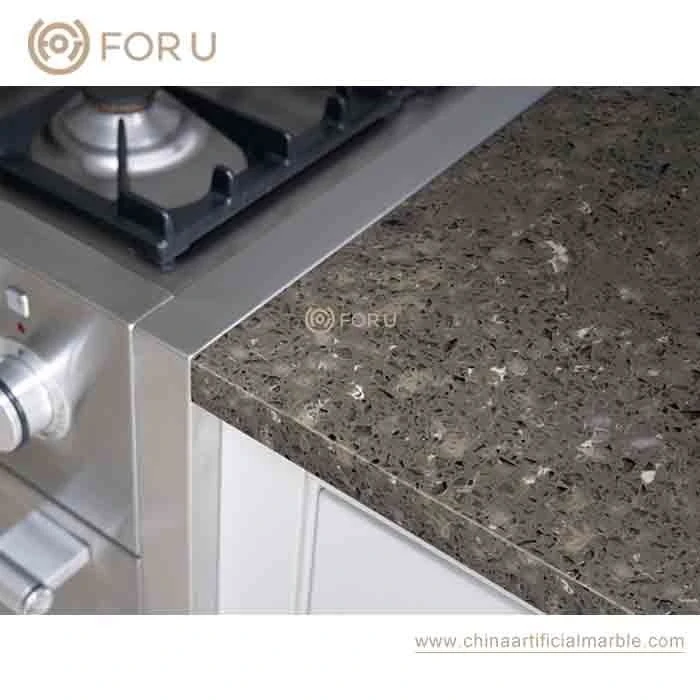
The plate is created by more than 50 tons of pressure die-casting, the hardness is not less than Mohs hardness level 5, and the density is 2.6g/ C m3. Quartz stone is the perfect mix of natural beauty and advanced technology. The water absorption rate of quartz stone is merely 0.02 percent, and it has a seepage resistance feature. The plate is cured at 150 degrees, giving it high-temperature resistance; quartz stone plates can tolerate temperatures up to 300 degrees.
When it comes to quartz stone conservation, it is said that it can survive 300 degrees, but many people would disagree. Quartz stone manufacturers present clients the required documentation, which claim that quartz stone can withstand 300 degrees of high temperature. However, because quartz stone plate frequently comes into touch with high-temperature materials and, due to its extreme hardness, is difficult to repair after a burst, we have some reservations regarding its high-temperature endurance.
What is the maximum temperature that a quartz stone plate can withstand? Or would you say more than 300 degrees, because the quartz stone sheet is constantly heated to 300 degrees? Many folks will wonder why they will blow up if they come into contact with a hot pan. Quartz stone is a brittle polymer composite material with specific thermal expansion and contraction properties. When the plate is locally heated, it cannot tolerate thermal expansion, and contraction occurs when internal stress is applied. The overall heat of the quartz stone plate is over 300 degrees, yet the local heat will cause the explosion to expand and contract due to thermal expansion and contraction. As a result, when dealing with quartz stone care, keep such objects at a distance.