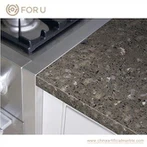
Is it worthwhile to invest in the recently popular "Porcelain Slab"?
I. What is a porcelain slab, and how does one obtain one?
The popularity of "porcelain slabs" is growing, and there is a slew of new porcelain slab releases.
It is novel material, according to some of them. It's been suggested that it's a more advanced form of ceramic tile.
Some argue that a porcelain slab is neither porcelain nor tile. Is it not fuzzy now that you've read it?
To put it another way, a porcelain plate is a breakthrough in the material qualities of our previous traditional ceramic materials, and it is classified as an advanced porcelain plate. Quartzite, granite, and a clay combination serve as their raw materials.
It's manufactured by simply grinding the stone into powder, compacting it using a 10,000-ton press, and burning it at 1300 degrees.
It is larger than conventional tiles, harder than real stone, more wear-resistant than quartz stone, and more resistant to fire than iron, in that order. It is more durable than other materials.
It can be used not just for a dining table, but also for a cabinet, a kitchen, a bathroom, a living room, a dining room wall/floor/countertop, and a number of other home locations.
What's the big deal about "porcelain panel"? It has to have qualities!


1. Natural antibacterial, hygienic, and safe! You can not only handle food directly on porcelain slabs, but you can also cook directly on them, and they are easy to clean with a damp towel!
2. High temperature fire resistance; if you burn it directly with fire, it will not deform; if you expose it to 2000 °C open fire, it will not cause any physical reflection, shrinkage, rupture, or discoloration, for example.
3, scratch-resistant, corrosion-resistant, Mohs hardness of more than 6 degrees, no scratches when scratched randomly with a steel knife Color soaking will not occur if the liquid is accidentally put on oily, acidic substances.
To summarize.
The porcelain board is safe and hygienic, and it is resistant to fire and scratches. It is both difficult and simple to clean.
However, there are some drawbacks: the creation of porcelain slabs is time-consuming, and the slabs are prone to burrs if not pressed hard enough.
Except for the expensive price, it's difficult not to like it when you consider the benefits and drawbacks.

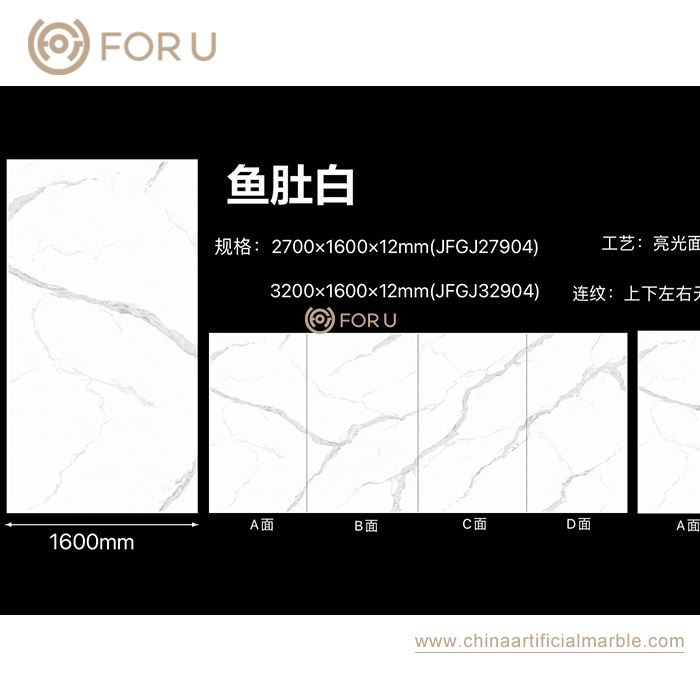
Second, how can you tell the difference between real and imitation porcelain slabs?
The better it is, the more counterfeits there will be! Since the start of the "porcelain plate frenzy" in the United States, many shops have been hanging sheep's heads to sell dog meat under the guise of porcelain plates sold but low-end ceramic slabs.
If you do not pay close attention to the business trap, you may fall into the trap of buying counterfeit items!
So, how can we tell the difference between real and imitation porcelain slabs and avoid buying the latter?
The following are a few options.
1. Because porcelain slabs can withstand high temperatures, we can bake them with fire to examine if there are any residues. It is true that there is no trace!
2. Take a look at the human physique. (Through the body indicates that the surface and the interior are the same color and pattern.) Porcelain slab blanks are through the body! The procedure of making an imitation porcelain slab is usually 3D printing, with only the surface layer.
3. Examine the board's sides and bottom. It's a porcelain slab if it's one piece and smooth. Tile without a doubt if it's lumpy and there's a little grid.
Tabletop thicknesses of 3mm and 6mm are relatively thin, hence a layer of glass is frequently required to complete the tabletop. Belong to the dining table with a composite porcelain slab.
Because the thin plate color has more diversity and options than the thick plate. As a result, many people like this type of composite porcelain slab dining table.
Specifications for a 9mm and 11mm dining table are as follows: These are low-end porcelain slate tabletop products made on the tile production line and process. However, the same can be done. The true porcelain slate goods are still quite distinct in terms of strength, durability, hardness, and other characteristics. This indicates that this is not a true porcelain slate table!
4Due to the scratch resistance of porcelain slabs, you can scratch the surface of the slab with metal objects and the true porcelain slab would leave no traces.
12mm thickness: The thickness of a true porcelain slate dining table is 12mm. Keep this thickness in mind when purchasing the thickness for direct use.
Specifications of 15mm and 20mm: this size is commonly used in cabinet countertops.
Summarize
The thickness of the real porcelain slab dining table typically used as a tabletop is 12mm, 6mm, 3mm, 3, and 6mm, with a layer of plexiglass support, 12mm directly with the line.
Leg of the table
The table legs, in addition to the tabletop, are another cost of the porcelain slab dining table.
Legs for a porcelain slab table Metal and solid wood class are the most prevalent support materials now in use.
1. Metal
1. High-grade 304 stainless steel electroplated titanium and black steel will not lose their paint.
2. Better, more cost-effective carbon steel, support, and plasticity.
3. The aluminum alloy offers a limited number of options, a simple shape, and general support.
4 iron frame, this is a low-end porcelain plate that will be utilized, iron, of course, will rust if the color falls off the paint.
Stainless steel is more expensive than aluminum, carbon steel is more expensive than iron, and iron is more expensive than stainless steel.
Solid wood is a type of wood.
Generally, ash and walnut woods, with metal and solid wood as alternatives.
Walnut wood is more expensive than ash wood.
To summarize.
Iron frames are commonly used in low-end porcelain slabs, while aluminum alloy frames, solid wood frames, or stainless steel frames are used in intermediate and high-end items.
In terms of texture and performance, the general choice of carbon steel or wood is offered. It all depends on your personal preferences.
Solid wood is a type of wood.
Generally, ash and walnut woods, with metal and solid wood as alternatives.
Walnut wood is more expensive than ash wood.
To summarize.
Iron frames are commonly used in low-end porcelain slabs, while aluminum alloy frames, solid wood frames, or stainless steel frames are used in intermediate and high-end items.
In terms of texture and performance, the general choice of carbon steel or wood is offered. It all depends on your personal preferences.