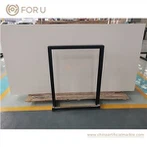
Difference between porcelain slabs & ceramic slabs
Let's start with a brief description
porcelain slab
English is called SINTERED STONE, Chinese direct translation "sintered stone"
Why do you say so?
Because porcelain slabs are made of natural raw materials such as quartz, feldspar, and oxides that provide color through a special process, pressed by tens of thousands of tons of presses, combined with NDD inkjet technology, and then sintered at over 1200°C.
Ceramic Board
It is called CERAMIC BOARD in English and is directly translated as "ceramic board" in Chinese.
Is a variety of inorganic non-metallic materials such as clay, ore, etc., by forming and then calcined at high temperatures below 1200 ℃ and other production processes made of an area of more than 1.62 square meters of plate ceramic products.

Said so many literary and straightforward descriptions, now to say the difference
One, size
porcelain slabs are generally larger than ceramic slabs.
porcelain plate conventional size 1000 * 3000mm, 1600 * 3200mm, 1500 * 3000mm, etc., the conventional thickness of 3/6/12mm ranging; ceramic plate conventional 900 * 1800mm, 1200 * 2400mm and other specifications.
Second, the water absorption rate
The water absorption rate of porcelain boards is lower than that of ceramic boards.
The water absorption rate of the porcelain board is only 0.02%, while the ceramic board is generally 0.5%. porcelain board generally has a higher density and is impermeable.
Three, more than 1200 ℃ high-temperature calcination
After being processed at a very high temperature, the porcelain board achieves Class A fire resistance and does not undergo physical changes or release odor gases when exposed to fire, making it a new product that can be used for cooking or grilling.
This is what the ceramic slab failed to do.
Four, true through-body
porcelain slabs are forged using through-body technology, which is better than most ceramic tiles in terms of toughness, and the addition of through-body technology makes the slabs seamless. The surface treatment of porcelain slabs requires very fine and complex processing technology, especially for restoring the transparency of stone and surface texture feel are extremely high requirements. Generally speaking, the surface process of porcelain slabs requires multiple fine high-definition inkjet processing in order for the texture to play a gradual and layered transition.

The advantages of porcelain slabs and ceramic slabs
Ceramic slabs.
1) Easy to process and cut (porcelain slabs require more professional processing services to achieve processing and application)
2) High plasticity, can be cut and matched at will, large size application, decorative effect of atmospheric integration, rich colors.
porcelain panel.
(1) fire resistance and high-temperature resistance, 2000 ℃ open fire near also properly does not produce any physical changes
2)Stain resistance
3)All-round applications, the use of the scope is not limited to decorative building materials can also be used for home panels
(4) flexible customization, according to the preferences of designers or guests for private customization, in line with your more imagination