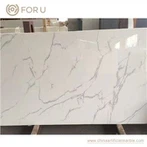
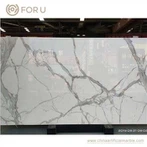
The composition of quartz slabs is the simplest silica, with glass luster, no cleavage surface, but with a shell-like fracture. Microcrystalline quartz slabs are called chalcedony, agate or jasper. Pure quartz slabs are colorless, but they show different colors due to impurities that often contain transition elements. Quartz slabs are very stable, not easy to weather or change into other kinds of minerals. According to the degree of crystallization of SiO2, it can be divided into crystalline single crystal slabs and polycrystalline quartz slabs. The luster of quartz slabs: glass luster. The color of quartz slabs: none, white, with a little gray, yellow to orange, purple, deep purple, pink, gray brown, brown and black. Streaks: white. Specific gravity: 2.65 ~ 2.66. Type of quartz slabs: metamorphic rock, metamorphosed from sandstone.
Formation process
Quartz slabs means that during the intrusive evolution of magma, due to changes in temperature, pressure and other conditions, hydrothermal fluids rich in SiO2 are differentiated, bedding and fissures penetrate the surrounding rock metamorphic rock series, or along the previous magmatic rock The contact fracture zone invaded, forming vein-like quartz slabs ore body.